Condition on same-scene views
Four same-scene references and a degraded target condition a Wan 2.1 model through VACE. A mask identifies the target view, and LoRA adapts the pretrained model for restoration.
UC Merced
* Equal contribution

 Degraded input
CoRest
Multi-view image collections often contain both sharp and degraded observations of the same scene. Viewpoint changes, partial overlap, and varying image quality make it difficult to reuse details from other views. CoRest adapts a pretrained video generative model to restore degraded images from same-scene references. During training, a frozen VGGT encoder associates regions across views so the model can retrieve relevant appearance features. At inference, CoRest uses the learned adaptation and reference conditioning, then returns each restored view to the reference pool. Experiments on DL3DV, ScanNet++, and ETH3D show gains in perceptual image quality, depth consistency, and feature-matching support.
CoRest learns to use cross-view evidence during training and restores a scene one target at a time during inference.
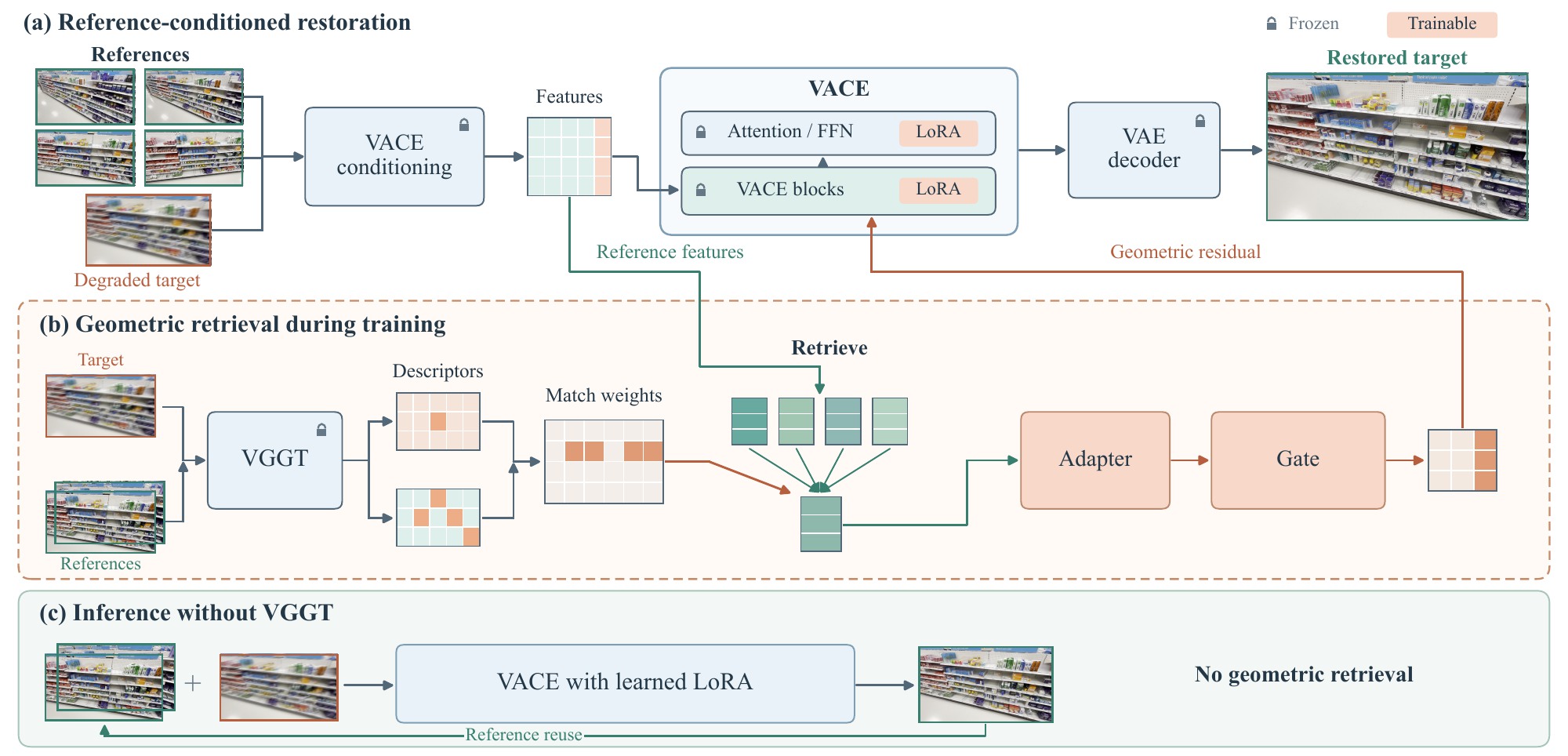
Four same-scene references and a degraded target condition a Wan 2.1 model through VACE. A mask identifies the target view, and LoRA adapts the pretrained model for restoration.
Frozen VGGT descriptors retrieve the four most similar reference tokens for each target token. CoRest aggregates their VACE appearance features and uses confidence and diffusion timestep to weight the correction.
At inference, OmniGlue ranks candidate references by match support. CoRest restores each target with the trained LoRA and VACE conditioning, then adds the output back to the reference pool. VGGT retrieval runs only during training.
Compare identical crops from the paper’s motion-blur benchmark at 50% degraded views.

 Degraded input
CoRest
* SIR-Diff reproduction. Drag the divider or use the arrow keys to reveal either image.
CoRest leads on DreamSim and MUSIQ across all nine dataset and fraction combinations. It also leads on LPIPS across all fractions on DL3DV and ETH3D.
| Method | LPIPS ↓ | DreamSim ↑ | NIQE ↓ | MUSIQ ↑ |
|---|---|---|---|---|
| Degraded input | 0.546 | 67.56 | 6.054 | 18.72 |
| NAFNet | 0.505 | 72.14 | 5.468 | 26.71 |
| MoCE-IR | 0.511 | 71.66 | 5.628 | 24.42 |
| R2R | 0.513 | 73.28 | 5.689 | 24.49 |
| VRT | 0.532 | 71.24 | 5.143 | 23.07 |
| BSSTNet | 0.525 | 73.54 | 5.238 | 23.77 |
| SIR-Diff* | 0.519 | 75.08 | 6.589 | 25.51 |
| GARD | 0.486 | 84.22 | 3.237 | 56.87 |
| CoRest | 0.369 | 94.53 | 3.177 | 71.20 |
Scores average the fixed degraded targets. The percentage is the share of scene views with motion blur. DreamSim is 100 × (1 − distance).
Restored views help downstream models estimate depth and find shared features across viewpoints.
Scroll each figure sideways to see all methods.
Depth Anything 3 predictions are compared with predictions from the clean scene after scale alignment.
AbsRel ↓ · Degraded input to CoRest · 50% motion-blurred views
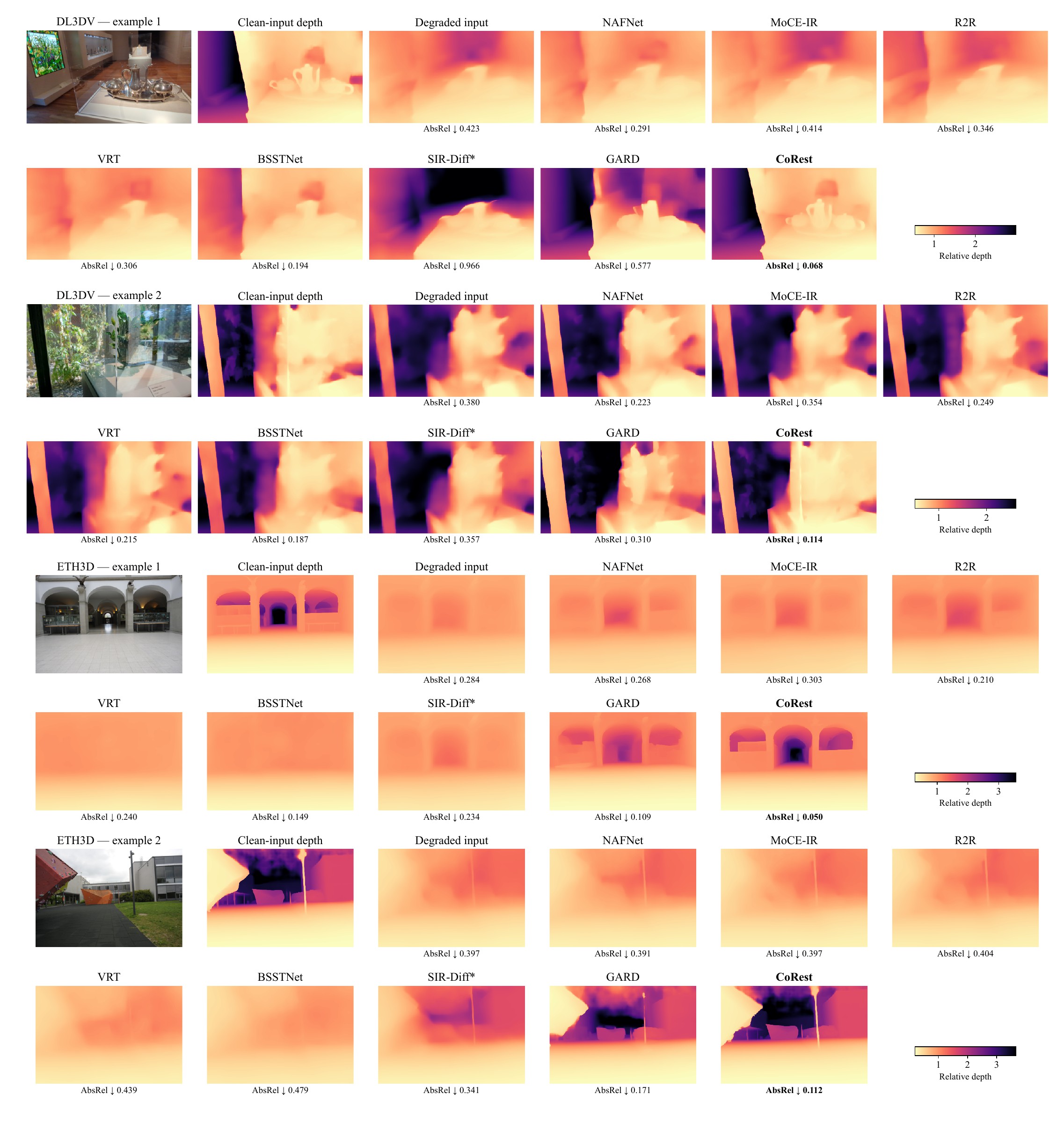
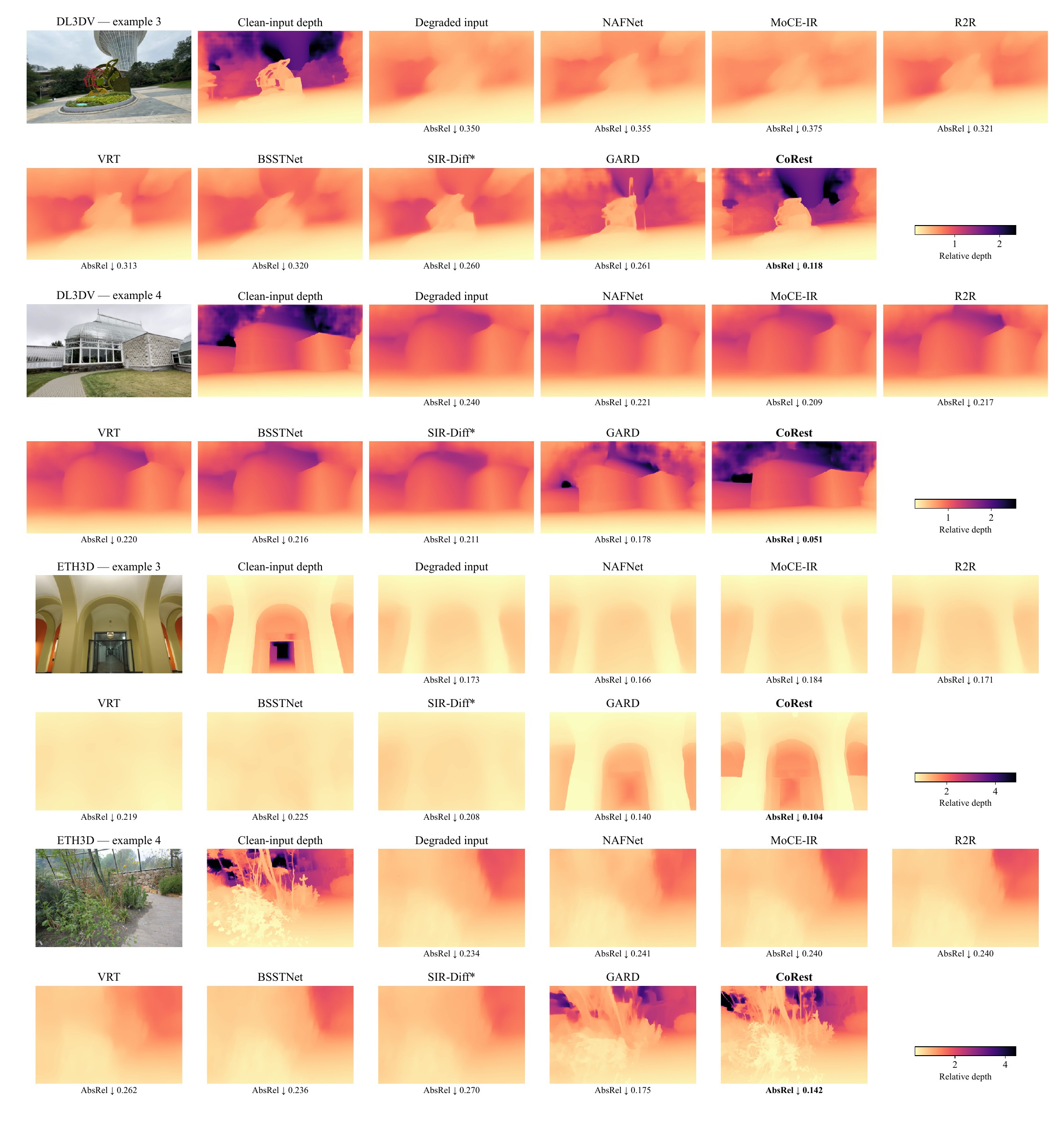
Depth maps for each target share a color scale. The clean-input map is a DA3 prediction. * SIR-Diff reproduction.
OmniGlue returns more correspondences on fixed pairs of restored targets.
Mean native match count ↑ · Degraded input to CoRest · 50% motion-blurred views
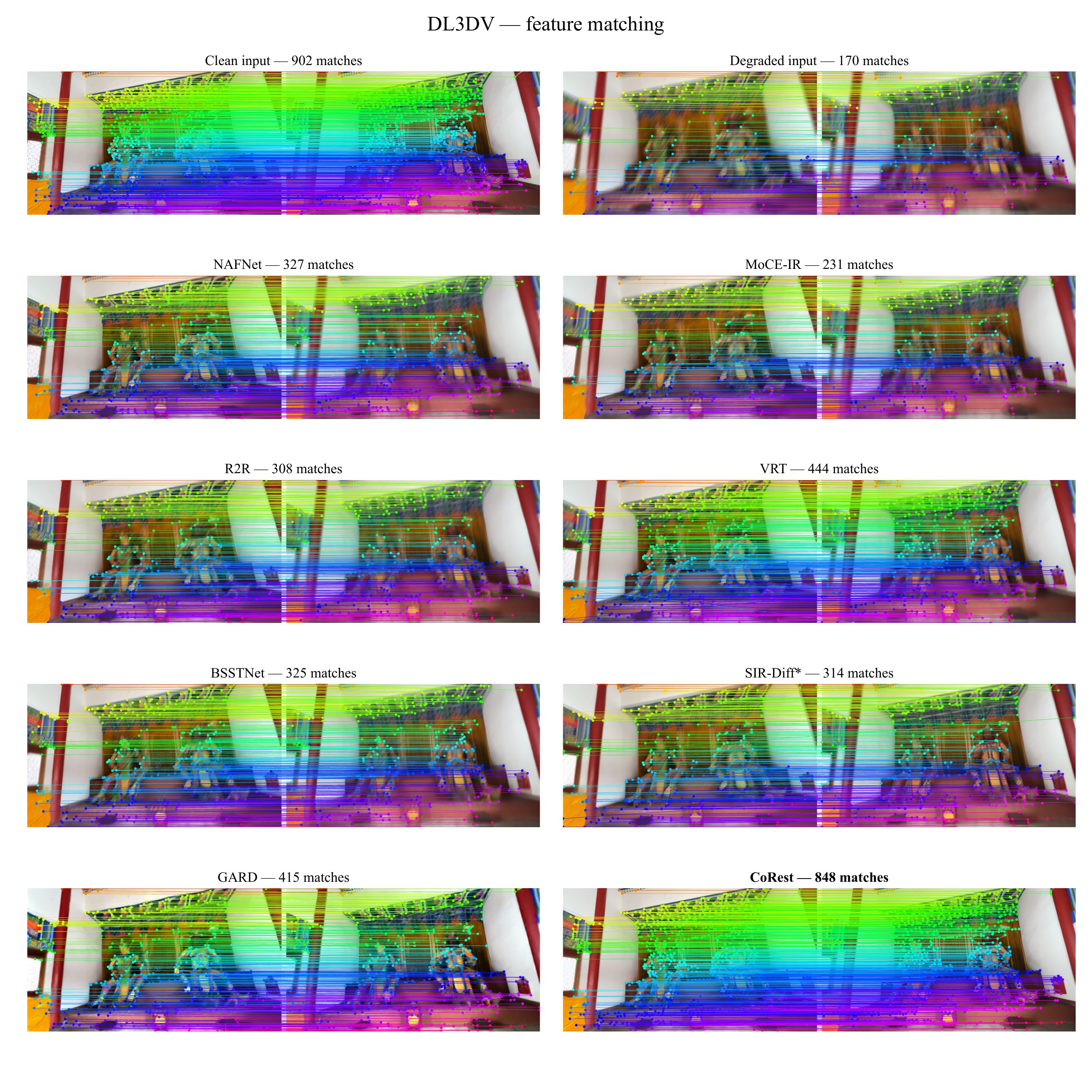
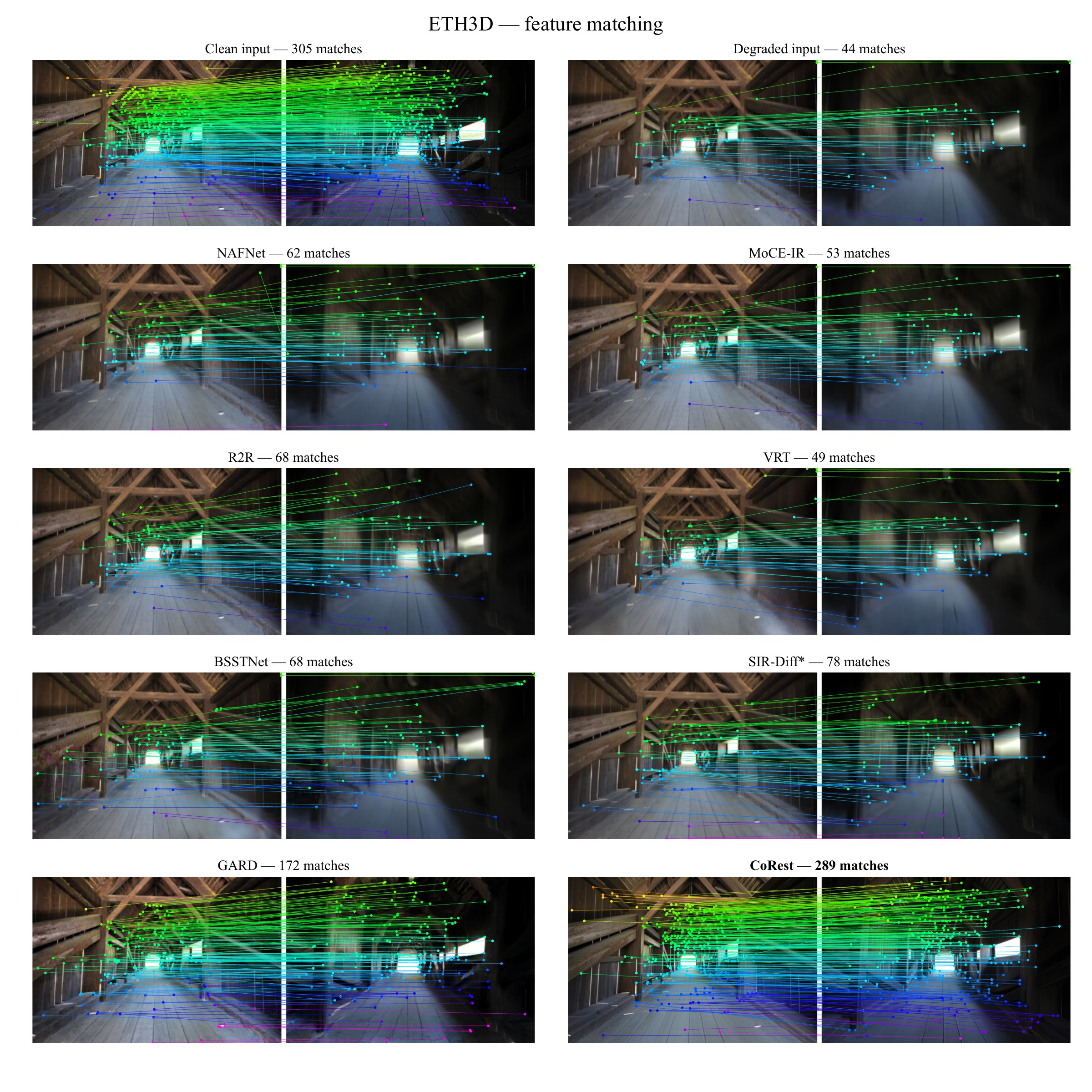
Counts are for the pictured pairs at OmniGlue’s native threshold. Line colors indicate match locations. * SIR-Diff reproduction.
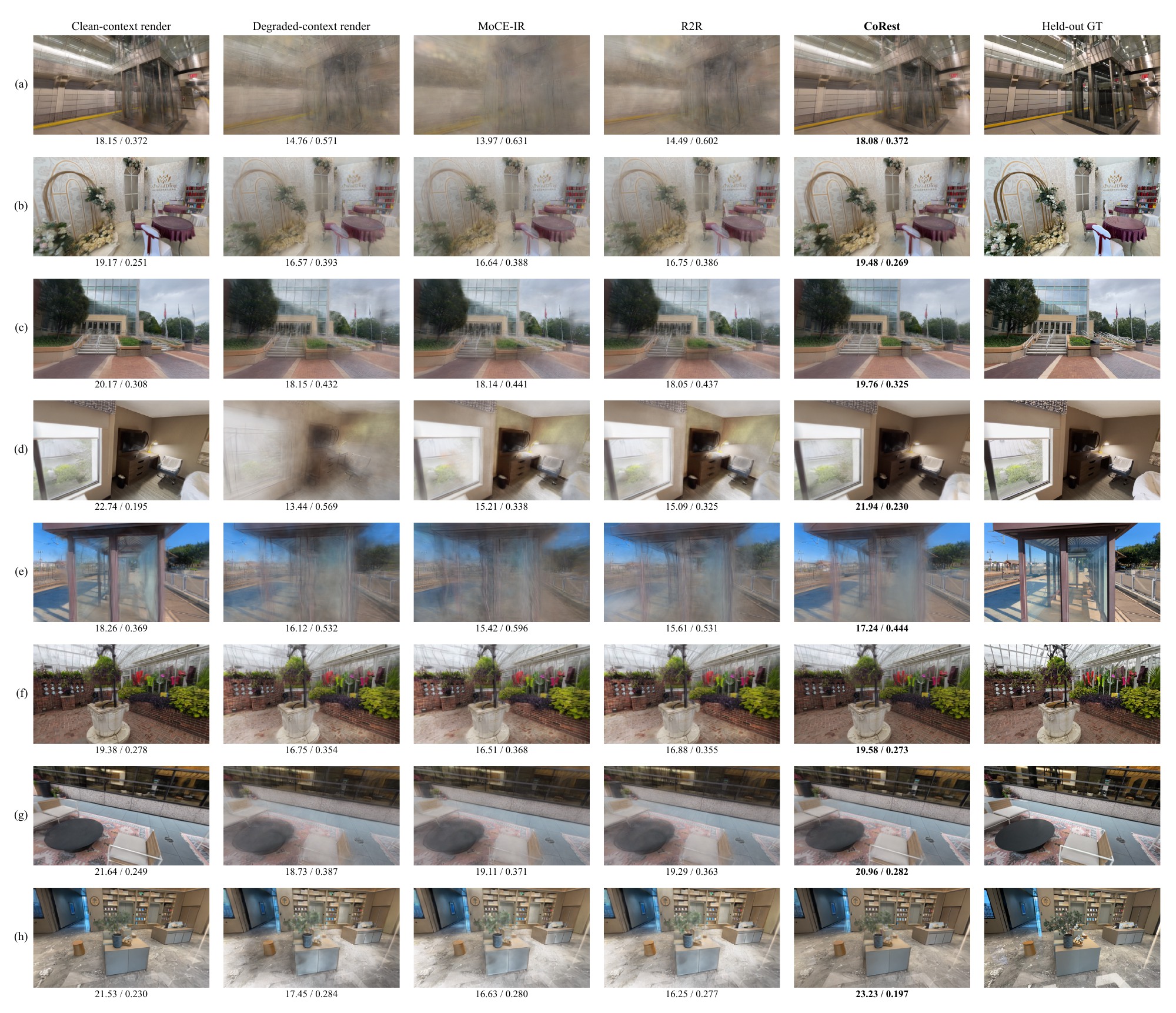
Depth Anything 3 renders held-out views from context images affected by motion blur, exposure changes, or both. At 50% degraded context views, CoRest improves held-out PSNR from 17.83 to 19.08 dB and reduces LPIPS from 0.344 to 0.321 compared with the degraded context.